
Optimized Consultation Time
Frees face-to-face visits for advanced clinical care rather than repeating baseline information.
See how it works
Now you can explain every diagnosis or procedure on video before seeing patients.
Frees face-to-face visits for advanced clinical care rather than repeating baseline information.
See how it works
Ensures every patient receives absolute consistency in pre-procedural details and risk comprehension.
See a sample scriptCultivates relaxed, cooperative patients who arrive thoroughly prepared.
View the evidenceInformed Care Media (ICM) is a Vancouver-based studio that produces custom patient-education videos for medical specialists. We bridge the gap between complex clinical procedures and patient comprehension. We standardize patient priming, helping high-volume practices eliminate repetitive exam-room explanations.
Our video solutions help you eliminate repetitive procedural explanations, saving you hours each week while ensuring every patient receives clear, consistent information directly from you.
Double-blind RCT · 500 patients · Surrey Memorial Hospital · Punjabi & Mandarin subtitles
Demonstrated a statistically significant reduction in pre-procedural patient anxiety.
Revealed a clear, documented trend toward smoother, faster procedures.
Maximized face-to-face consultation time.
“If each video is 10 minutes long and I’ve shown it 5,000 times… that’s so much time I didn’t have to say those things verbally.”
Pick one explanation you give every day, then adjust the two sliders to match your clinic.
Video doesn’t replace your time with patients. It replaces repeating the same script over and over. Patients watch in the exam room while they wait, so when you walk in, they already know the basics. You spend a short time reviewing what they’ve learned and the rest of the visit on what matters most: their questions and their care.
Estimate based on 5 clinic days a week, 21 a month, 230 a year. Most clinics have several explanations like this, so the real total is higher.
You're about to have cataract surgery, and there are a few simple things you can do to help it go quickly and smoothly.
The surgery usually takes less than fifteen minutes, and most people find it much easier than they expected.
The most helpful thing you can do is keep your head still and facing straight up.
Keep both eyes open and try not to squeeze them closed. The light is bright at first and eases after a minute or two.
Look straight ahead at the lights. If you need to cough or sneeze, just tell me first so we can pause.
What you'll see on shoot day: your script, on the teleprompter, at your pace.
We start from our own script templates, written procedure by procedure, then shape them around the words you already use with patients. You approve every line before we film.
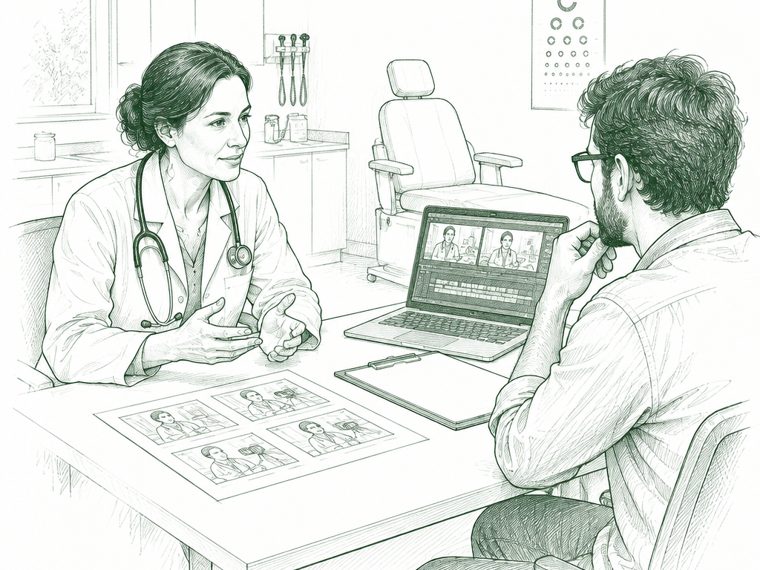
Our team transforms your educational goals into a clear, actionable plan. We handle the logistics and script development.
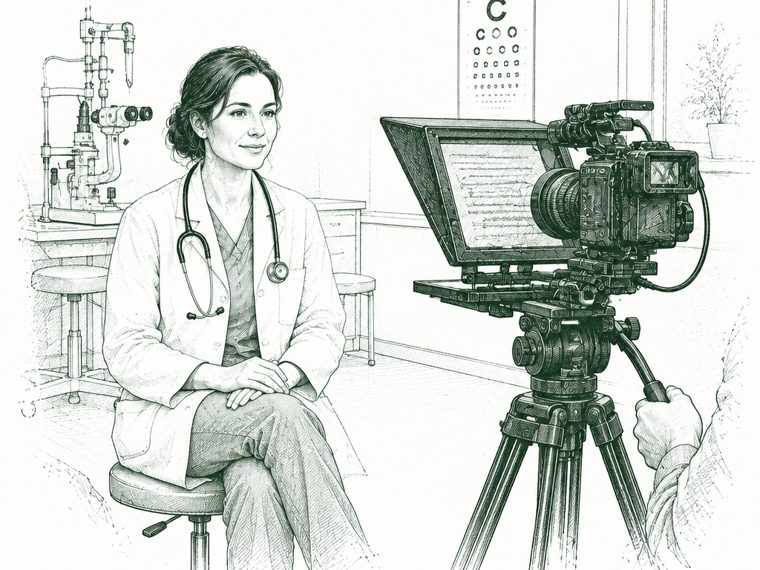
We take the words you use with patients every day and prepare them for the screen. There is no memorization required; we use a professional teleprompter.
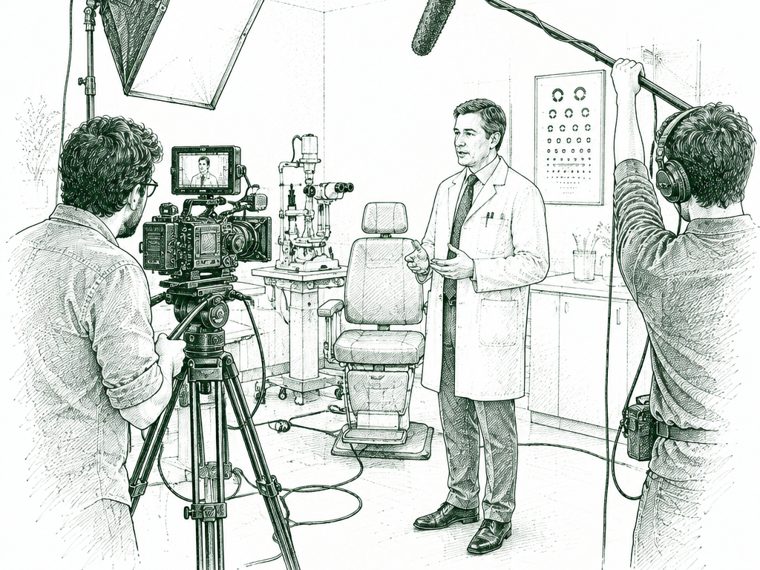
Our crew and gear arrive at your clinic to execute the plan. We film you in your own environment, ensuring your patients see the trusted expert they know.
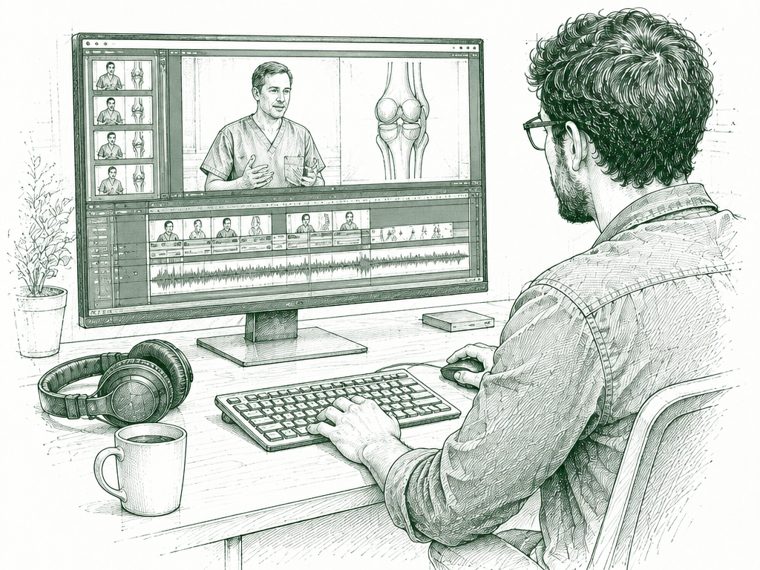
After the shoot, we handle all post-production. We add professional graphics and animations to clarify complex points.
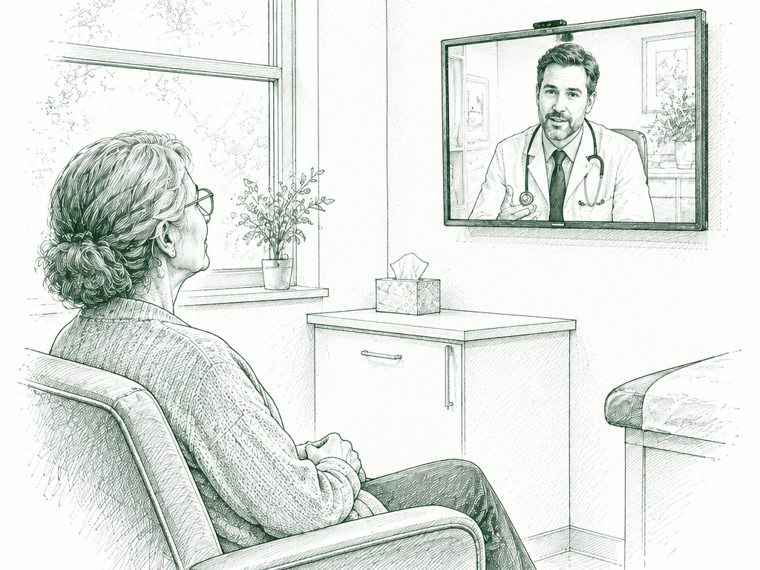
We help you integrate these videos into your daily workflow. Whether it's in the exam room or a surgery center, your patients arrive informed, empowered, and ready for a focused discussion.
Every library is quoted to fit the clinic. Cost depends mainly on how many videos you need and how much custom graphics and animation each one calls for. Our streamlined post-production workflow cuts much of the editing time that used to drive costs up, and those savings go to you. After a short call, we send a fixed quote with no surprises.
Start with the explanations you repeat most, usually pre-op instructions, consent risks and post-op care. Most clinics begin with a core set and add more once they see the time saved. Filming several videos in one shoot day keeps the cost per video down.
Our goal is to minimize your time commitment. We begin with a collaborative planning session to structure the content, identify all required materials, and set a production date. Since most of your core material is already memorized from your daily practice, preparation largely involves finalizing the dialogue. For the majority of our clients, this amounts to only 2–3 hours of final review and rehearsal prior to filming.
Plan on about half a day in your clinic. Our crew needs 1–1.5 hours to set up lighting, camera and teleprompter, then filming takes 2–3 hours, depending on how many videos we're covering. We work around your schedule.
If we're also filming supplemental footage, such as b-roll in the OR or procedure room, allow some extra time. We'll map this out with you during planning.
Around two weeks from shoot day to delivery.
Authenticity is our priority. We start by capturing the precise explanations you use with patients every day. To ensure clinical accuracy and clarity, you retain complete control over the content while it is being drafted. During filming, we use a professional teleprompter placed in front of the camera lens, allowing you to read your dialogue to the camera while maintaining direct eye contact. Your trusted instructions come across in an authentic voice that connects with patients, with clinical precision and none of the repetitive talking on your part throughout the day.
Absolutely. We specialize in making subject matter experts comfortable. Our production team uses a professional teleprompter placed directly in front of the lens. This eliminates the need for memorization, so you deliver your dialogue with smooth, confident eye contact. You speak directly to your patients every time, without the stress of performing.
There are two ways to do this:
Either way, you'll need to validate the language used in the finished video with a native speaker. We can cover this in an initial pre-production meeting.
You do. You approve the script before we film and review the edit before delivery. Nothing reaches your patients without your sign-off.
Yes. Upon completion and delivery, you receive 100% full copyright and ownership of the final video files and all content within them, including perpetual rights for all medical graphics and footage used in the production. The videos are yours to use across your patient portal, website, waiting rooms, and electronic health records without limitation.
Wherever suits your clinic: an exam-room screen, a waiting-room display, a tablet, your website, or a link sent before the appointment. We'll help you set up whatever fits your patient flow.
No. Our first libraries were for ophthalmology, but the approach works for any specialty that repeats the same explanations, from cardiology and orthopaedics to surgery and dentistry.
Stop repeating the exact same pre-op protocols, informed consent risks, and post-op instructions a dozen times a day.
Feel free to email or call our team to learn more.